
company7 min read
Palantir for the Rest of Us
Why we stopped pitching Inferal as a database and started pitching it as operational intelligence.
Blog
company7 min read
Why we stopped pitching Inferal as a database and started pitching it as operational intelligence.
perspectives8 min read
Applications have been the center of software. AI gives us a chance to put the person, their role, and their goal there instead.

perspectives6 min read
Why do businesses have to rewrite working systems just to keep the same reports, approvals, and invoices running?

perspectives5 min read
Our systems already disagree about what things mean. Inferal is designing for a million small ontologies that make those differences explicit enough to act on.

engineering4 min read
When a business rule includes time, the system can act at the relevant boundary instead of polling every day.

perspectives5 min read
Rules make business logic visible. Implication graphs make consequences traceable. That difference matters when every operational decision has a downstream path.
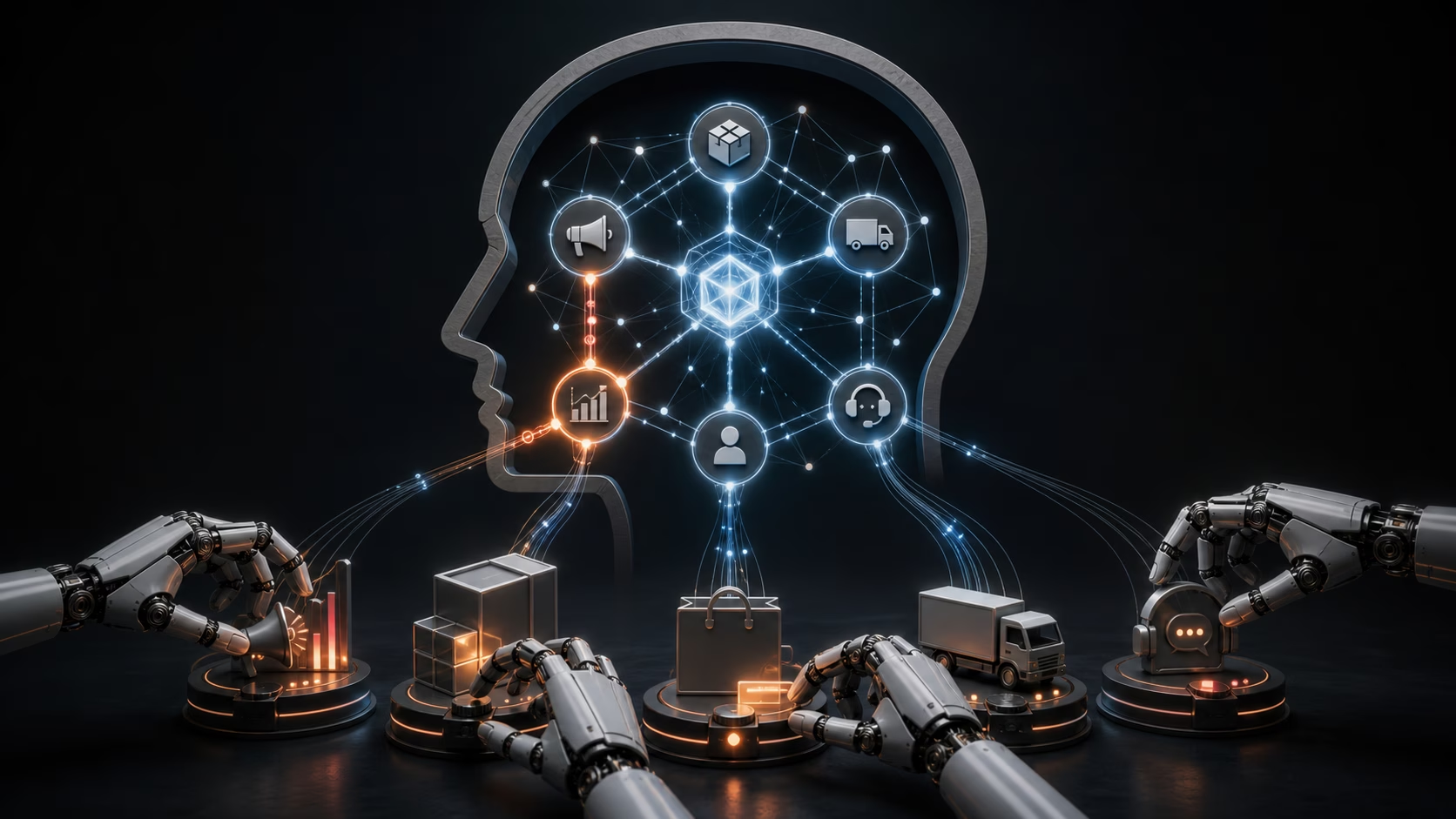
product5 min read
AI agents can call APIs and make decisions, but they have no model of how your business runs. That gap is an operational model problem, and it's what Inferal solves.

engineering8 min read
Why efficient systems need callers to say what they need, when they need it, and what they will do next.

tutorial8 min read
In 1985, NASA built a rule engine called CLIPS. Forty years later, it still has lessons for every developer whose business logic is buried in procedural code.

perspectives7 min read
The principle everyone agrees on. The application everyone gets wrong. What if data and code were never separate concerns?

engineering5 min read
What happens when your data system has no idea what you're going to do with the answer.

perspectives5 min read
What if conventional hiring has the priority order backwards?

perspectives6 min read
Most rule engines failed to gain adoption because database integration was weak. In today's fragmented data landscape, getting data in and decisions out isn't optional. It's the foundation.

perspectives8 min read
Temporal, DBOS, Windmill, and Lambda Durable Functions solve state durability. But code itself is the problem: workflows aren't sequences you build. They emerge from conditions. And code can't express emergence.

engineering7 min read
We ran experiments to find out why AI agents forget project-specific rules. The results were surprising: less is more, prohibition beats reframing, and recognition doesn't equal adherence.

perspectives5 min read
Traditional databases follow a request-response pattern that leaves agents waiting, ignorant, and inactive. Agent-native systems flip this model.
engineering6 min read
A deep dive into our Git-based workspace that combines knowledge management, multi-repository operations, and AI-native integration through MCP servers.